MNA logo link About MNA
|
How You Can Help
|
MNA Sanctuaries
|
|
About MNA
   History
   Mission
   Contact Us

Meet the Staff
   MNA Staff

Meet the Board
   Board of Trustees

Support Our Efforts
   Become a Member


roots

Roots image

divider

MNA’s History In Brief
What started as a small bird study group transformed into a state-wide land conservation organization.  In 1951, Bertha A. Daubendiek and a few of her friends started a group to study birds. The group started out with a mission to protect ecological diversity and to educate people about Michigan’s diverse wildlife. This mission was revised over time as the organization expanded its ideology to accommodate land acquisition and conservation.       

A Glimpse Into The Past
The group’s first project to protest the destruction of a tern colony at Metropolitan Beach in Macomb County was met with success when they managed to bring the project to a halt. This is also when the organization’s first name change came about to the St. Clair Metropolitan Beach Sanctuary Association. Soon the group established weekend nature exhibits, guided tours and a study course all with the motive of conserving and protecting Michigan’s special natural areas.

The organization changed its name to the Macomb Nature Association in 1954, establishing a conservation exhibit, and traveling to all schools in Macomb and St. Clair counties by 1957, hoping to change the way development was being carried out in the greater Detroit area through education. Children who attended the exhibits were invited to join the Junior Nature Patrol, a group oriented toward educating children about the environment.  

Seven years after its inception, with continuous educational efforts, the Association broadened its approach from education to land preservation and acquisition.  The term nature sanctuary was first coined, owners of 95 prospective nature properties were contacted, and $15,000 was borrowed to purchase the first sanctuaries.

The Macomb Nature Association made its first land purchase in 1960, acquiring the 40 acres in St. Clair County now called the Louis G. Senghas Memorial Nature Sanctuary.  This purchase was shortly followed by three more: the Bertha A. Daubendiek Memorial Plant Preserve, Steven M. Polovich Memorial Plant Preserve, and Trillium Trail Nature Sanctuary.

Due to rapid land acquisition and consequent expansion, another name change came about in 1965, when the organization changed its name to the Eastern Michigan Nature Association.  The Association purchased more properties and was given a significant monetary contribution that resulted in the purchase of eight sanctuaries in northern Michigan, leading to the final name change to Michigan Nature Association (MNA) in 1970.

By 1971, MNA had grown so large that Bertha Daubendiek, founder of the group in 1951 and executive secretary since 1952, changed her part time volunteer status to full time. MNA continued to protect Michigan's wildlife, and in 1974 Bertha received an award as one of Michigan's top ten volunteers by Governor Milliken.

MNA started to see they were on the right track. Endangered species lists for Michigan and the rest of the country were published, revealing that a significant percentage of the species on the list (endangered, threatened, and rare) were already protected in MNA preserves and sanctuaries. 1978 brought about the first show of support by another conservation organization in Michigan, The Detroit Audubon Society, which purchased 75 acres next to an MNA project in St. Clair County. They later purchased two additional parcels, protecting a total of 224 acres in this joint effort." Also around this same time, Charles Eshbach published, "From Sawmill to Sanctuary, The Estivant Pines Story," dedicated to MNA's effort to save the pines.

By 1979, MNA had achieved a goal of 50 wholly owned sanctuary-preserves. Also in this year, Bertha Daubendiek was recognized for her work again by the Detroit News as Michiganian of the Year.
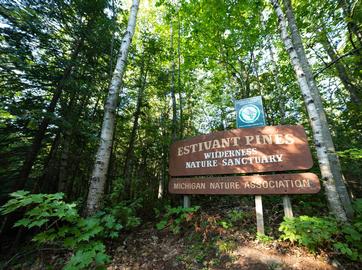
The early 80's were abundant in land purchases. MNA added 16 sanctuaries and preserves in just two years. The Michigan Nature Association also experienced a tragedy in this same time period. The Leaning Giant, Michigan's State Champion White Pine and runner up for the National Champion White Pine, in the Estivant Pines was damaged by fire. Later because of this fire damage and gale force winds, the Leaning Giant fell to the ground.

After just five short years from the previous goal of 50 sanctuaries, MNA reached another mile marker. The American chestnut project achieved its goal of having every Michigan native tree species on MNA preserves. This was also the 99th project for MNA. These were two great achievements by a small organization.

Over the next few years MNA continued to purchase more land and take more steps against developing the natural habitat. MNA had convinced the Oakland County Road Commission to re-route a road that was proposed to run through one of MNA's Sanctuaries. They had also accumulated more properties now; the count was up to 110 preserves and sanctuaries. Another publication was also underway; Bertha Daubendiek and Edna S. Newnan had been extremely busy over the last year assembling In Retrospect, a book highlighting the past 28 years of preserving Michigan's wild and rare natural lands. The publication also served as a guide to 26 of MNA's easiest to visit sanctuaries and consists of 221 full-color nature photos taken on MNA lands by 41 Michigan photographers. The proceeds from the sales go to the MNA Endowment fund.

In 1989 another book was printed: Walking Paths in Keweenaw by Charles Eshbach. Mr. Eshbach reported that during the first two weeks of October there was an average of 1,000 visitors per day at the Estivant Pines.

1990 was a busy time for fundraising around MNA headquarters. MNA received a total of $286,000 for the Estivant Pines. A 10-acre Memorial Grove was established with contributors who gave $5,000 per acre. The sanctuary was increased to 377.5 acres. MNA also ended its four-year search for a spruce grouse sanctuary. MNA was still purchasing other properties in the Keweenaw Peninsula; in 1992, four more sanctuaries were purchased in Michigan's Upper Peninsula.

1994 was yet another busy year for MNA. In addition to the preservation and education activities, they published the 7th Edition MNA Nature Sanctuary Guidebook.

The Dauner Martin Nature Sanctuary was added in 1997. This is one of MNA's larger properties consisting of 174 acres. Other sanctuaries and preserves that were added this same year include: White Cedar Swamps, Baraga Old Growth Forest, Scapaticci, Bullar Lake Fen, Riley Shurte, Sand Creek Prairie, and an addition to Gratiot Lakebringing the count for MNA to nearly 150.

In 2001, Bertha Daubendiek announced her retirement as Executive Secretary. In December of that same year, Jeremy Emmi began work as MNA's new Executive Director.

In 2002, MNA relocated to the city of Williamston, to be more centrally located in the state and be closer to a major university system (MSU).

In 2003, MNA began to develop a strategic vision for the organization, focusing on expanding our acquisition program while adequately maintaining our existing nature sanctuaries and plant preserves around the state. In spring of 2004, we started our new stewardship program with the hiring of Statewide Stewardship Director Sherri Laier. Our stewardship program then encompassed over 150 nature sanctuaries and plant preserves relyaing on the maintenance by our staff and hundreds of volunteer stewards who look after these natural areas with guidance from MNA.

In August of 2004, MNA kicked off its Statewide Land Protection Campaign, which was a three-year, $3 million campaign to protect ten properties in the Lower and Upper Peninsulas. In 2008, MNA continued to grow, gaining new members and building a top-notch stewardship program, as well as partnering on our first joint-owned project in Presque Isle County.  This project protects a rare limestone geologic formation jointly with the Michigan Karst Conservancy. 

In 2009, MNA began developing a strategic plan to lead the organization into the new decade, and 2010 saw the protection of land in our 57th county and the expansion of our stewardship program.  MNA’s efforts to protect Michigan’s highest-quality natural habitats are increasingly supported by a wide audience across Michigan.  We invite you to join our efforts and enjoy the fruits of our success.


Back to top


|
|